

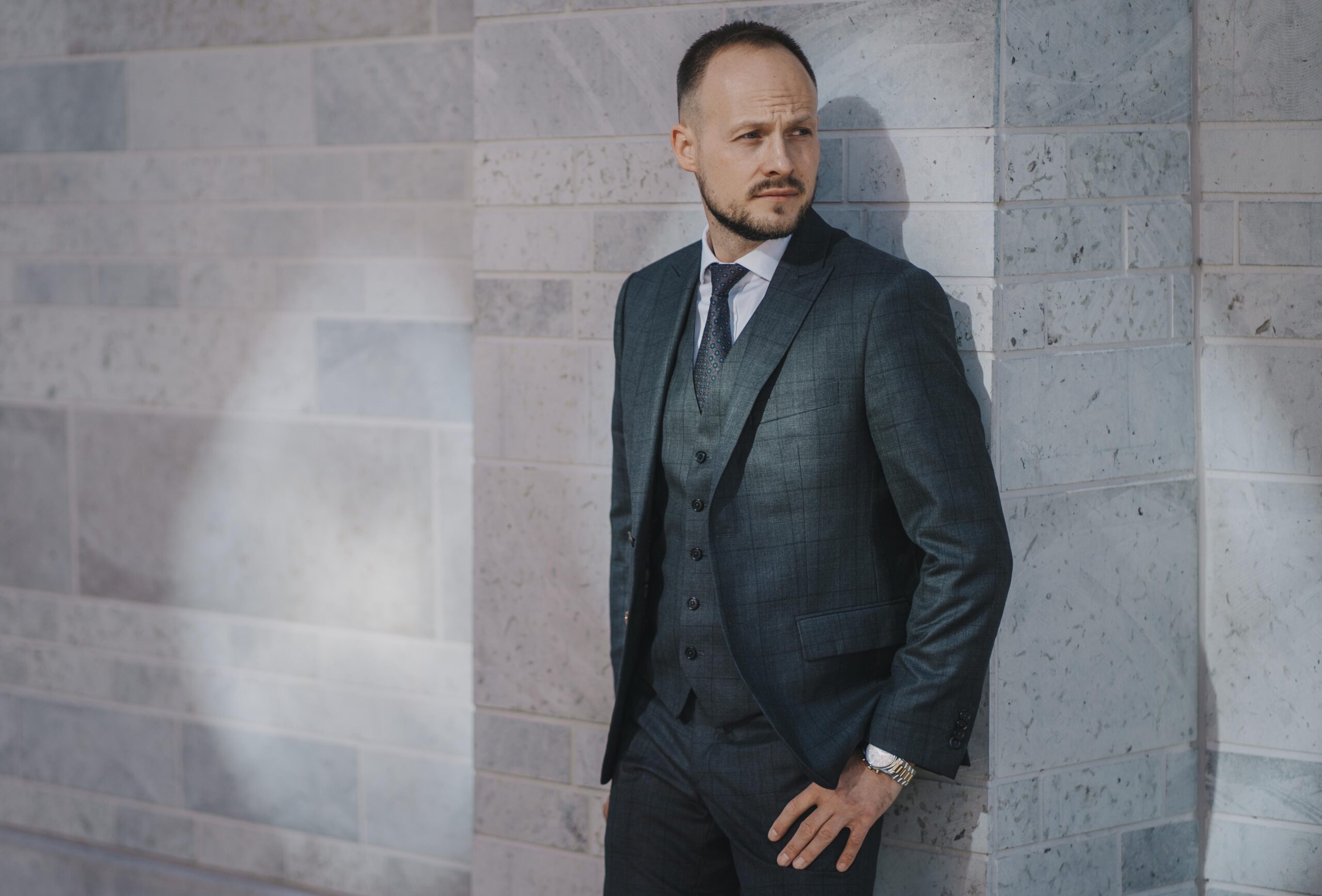
Hardi Põder
A midlife crisis in a successful founder rarely looks like a sports car. It looks like a question that arrives at 3 a.m., after the win: Is this it? On average, life satisfaction dips in the late 40s, but only a minority of people describe an actual crisis. Founders get their own version, because the usual medicine, the next achievement, is the thing that stopped working.
IS THIS IT?
It arrives at 3 a.m., and it arrives after the win, never before. That’s the tell.
If it came during the struggle, you could dismiss it as stress. It comes after the exit, after the round, after the number. That’s when it has your full attention.
I spent twenty years building nine companies. Each one more “successful.” Each one more empty. I wasn’t building businesses. I was building walls between me and one terrifying question:
↳ What if there’s more to life than this?
Is the midlife crisis real?
The dip is real, modest and still debated. The crisis, in the cinematic sense, is rarer than its reputation.
The term comes from the psychoanalyst Elliott Jaques, who introduced it in a 1965 paper called “Death and the Mid-Life Crisis” (Jaques, 1965). He first noticed it in the lives of great artists in their mid-to-late thirties, and his central point still lands: somewhere in the prime of life, your own death stops being theoretical.
The well-being data point to the same stretch of life, a little later. Across 145 countries, life satisfaction was lowest on average around age 48, and closer to 47 in developed countries (Blanchflower, 2021). The dip is modest, and researchers still argue about how much of it holds up when you follow the same people over time (Galambos et al., 2020).
A crisis is something else. In a US survey of 724 adults, more than 90 percent could define a midlife crisis, but only 26 percent said they had had one, and most blamed it on major life events rather than on age (Wethington, 2000). A later review puts it at 10 to 20 percent of adults (Lachman, 2015).
Read that again.
Most people go through a harder stretch in midlife. Far fewer blow up their lives. The difference is usually what happens around them and what they do with it.
Why do successful people have a midlife crisis?
Because success removes the excuse.
When you’re struggling, the emptiness has an explanation: once we make it, it’ll be different. Then you make it.
In a German study that matched 132,609 forecasts of life satisfaction with what people later reported, the young consistently expected to be more satisfied five years on than they turned out to be. By midlife, that optimism runs out (Schwandt, 2016).
↳ Most founders I know didn’t underachieve. They over-expected.
There’s a name for the version that hits right after a goal is reached: the arrival fallacy. I’ve written more about it in why success can feel empty.
And it isn’t only a feeling. In data on about 500,000 people in rich countries, economists found that sleep problems, alcohol dependence, intense job strain and severe depression all peak in midlife, around the ages when people are close to their peak earnings (Giuntella et al., 2023).
Founders get a sharper version, for three reasons.
The peak and the question arrive at the same age. US Census data on 2.7 million founders show that the people who started the fastest-growing new firms were, on average, 45 when they founded them. In the researchers’ words, “successful entrepreneurs are middle-aged, not young” (Azoulay et al., 2020). So the decade in which many founders build the biggest thing of their lives is the decade in which the well-being curve bottoms out. The result and the question can land in the same quarter.
The company is your identity. When the company is who you are, every exit, merger or plateau is a small death. Every time one of mine got difficult, I started another. I called it entrepreneurship. It was avoidance with a business plan.
Mortality starts arriving through other people. A parent gets sick. A friend doesn’t make it to 50. Your children stop needing you in the same way. That was Jaques’s point, sixty years ago.
Tim Carter spent two decades as Global Brand Director at Virgin. He had just lost his brother, and his father’s health was failing:
“So you kind of get to this point where you’re like, is that all there is, or is this it? And so how do I optimize the next period of my life? Because impermanence implies to me as well.” — Tim Carter, former Global Brand Director, Virgin (his story)
What mine looked like
I started 2025 recovering from a back injury. Nine months of near silence, asking a question I’d never let myself ask: will INLIBRIUM even survive?
Pain messes with your identity. It whispers: Is this it?
Then, this year, my older son turned 18. When I looked at him, I saw myself and I knew exactly where he’d learned it. When I went looking for the root, I found my own father. We talk like two strangers who happen to know each other’s names.
↳ A pattern you refuse to face doesn’t end with you. It gets handed to the people you love most.
That’s the part of midlife nobody puts in the sports-car jokes. It’s about your own mortality, and just as much about what you’re about to hand down.
What is a midlife crisis asking for?
Psychology has had an answer for more than seventy years. Erik Erikson described the central task of midlife as generativity versus stagnation: either you start investing in people and work that will outlast you, or you slowly turn inward (Erikson, Childhood and Society, 1950). Later researchers learned to measure it, and in one study fathers scored higher on generativity than men without children (McAdams & de St. Aubin, 1992).
In plain language, the second half of life asks for whom? More than what next?
There’s a practical version, too. Arthur Brooks argues that the second half rewards different skills: less raw problem-solving speed, more judgment, synthesis and teaching (The Atlantic, 2019). The research is messier than the slogan, but it points the same way. In a study of more than 48,000 people, different abilities peaked at very different ages, and vocabulary peaked around 50 or later (Hartshorne & Germine, 2015).
Founders who keep trying to win with first-half skills feel the decline. The ones who switch curves often find their best work is still ahead.
Tim put the switch in one sentence. He now runs a company with his sons: “…it’s pushing me to be present for them and mentor them. After all of these years of gaining intelligence and wisdom, you have a role to play in their lives.”
Mine was less elegant. At 41 I applied to study psychology at Tallinn University, alongside a year-and-a-half course in psychodrama. I didn’t get in this time. I’ll apply again next year. The goal hasn’t moved: a PhD by 50. Not for the paper or the title. Knowing yourself is the only soil rich enough to help anyone else grow.
↳ Growth never asks your age. It just waits for your courage.
What not to do while the question is loud
Don’t start the next company to make it go quiet. I tried it. Nine times.
Don’t make irreversible decisions in the first months. The question is real. Your first answers to it usually aren’t.
Don’t numb it. Not with alcohol, not with an 80-hour week, not with an expedition. A bigger mountain is still a way of leaving.
Don’t do it alone. Your pattern is smarter than your insight. It will dress itself up as good judgment.
What helps
Treat it as information. Write the question down. When does it come? After what? It’s telling you something specific.
Talk to a professional. Not your board, not your coach. A licensed therapist with no stake in your company.
Invest in two relationships on purpose. A child, a partner, a parent. Put them in the calendar before the company does.
Become a beginner at something. Being bad at something in public is the quickest way I know to loosen an identity built on being good at things.
Ask “for whom?” instead of “what next?” The answer is usually already in your life. You’ve been too busy to look.
Some leaders look at psychedelic retreats at this point. If that’s you, read what integration actually involves first. The experience is the smallest part of the work.
Your move, leader
If the company sold tomorrow for the number you once dreamed of, what would you do on Monday?
Who would you call first, and would they pick up?
What are you handing down to your children without meaning to?
If you have to think hard to answer, that is information.
If your honest answer is “I don’t want to look,” that is the loudest information of all.
You built an empire. Now build a life.
↳ They are not the same project, and the first one does not automatically produce the second.
Cheers,
Hardi
P.S. — If the question has been arriving at 3 a.m., the “Is This It?” assessment is twenty questions across five dimensions. Four minutes, and your answers never leave your browser. It isn’t a diagnosis. It makes a pattern visible.
P.P.S. — INLIBRIUM is a six-month, medically supervised program that Monika Jakobson and I built for founders and executives who have won the external game and gone quiet about the rest. If you’d like a private conversation, my inbox is open.
About the author -
Hardi Põder
For clients carrying the strain of sustained responsibility, Hardi Põder helps make INLIBRIUM a disciplined, coordinated six-month process rather than a collection of disconnected interventions. As CEO & Co-Founder, he brings an operator’s understanding of what performance can conceal and what it takes to build a structure capable of meeting a client over time.
Before founding INLIBRIUM with Monika Jakobson in 2021, Hardi spent roughly two decades building nine companies across agriculture, IT, retail, and biotech. His work included leading sales teams of more than 600 people across Scandinavia and the United States, as well as building an outdoor medicinal-mushroom plantation. That background informs a practical standard for the company: complex work should be organized clearly, individualized carefully, and carried through consistently.
Hardi’s search after burnout clarified a gap he had seen in the field. A powerful psychedelic experience can create insight, but insight alone may not alter the conditions and habits that shape daily life. He and Monika founded INLIBRIUM to build a more complete model around preparation, clinical screening, psychological care, health review, and sustained integration.
The model Hardi helped establish links three private residencies with months of planned work. Psychological, health, and leadership specialists remain connected around the same client. As CEO, he leads the company responsible for that model; clinical decisions and care rest with appropriately qualified practitioners.
He is clear about the limit of any single element. The substance may be a catalyst, but preparation, judgment, and disciplined follow-through determine whether insight can be carried into a life.